Introduction
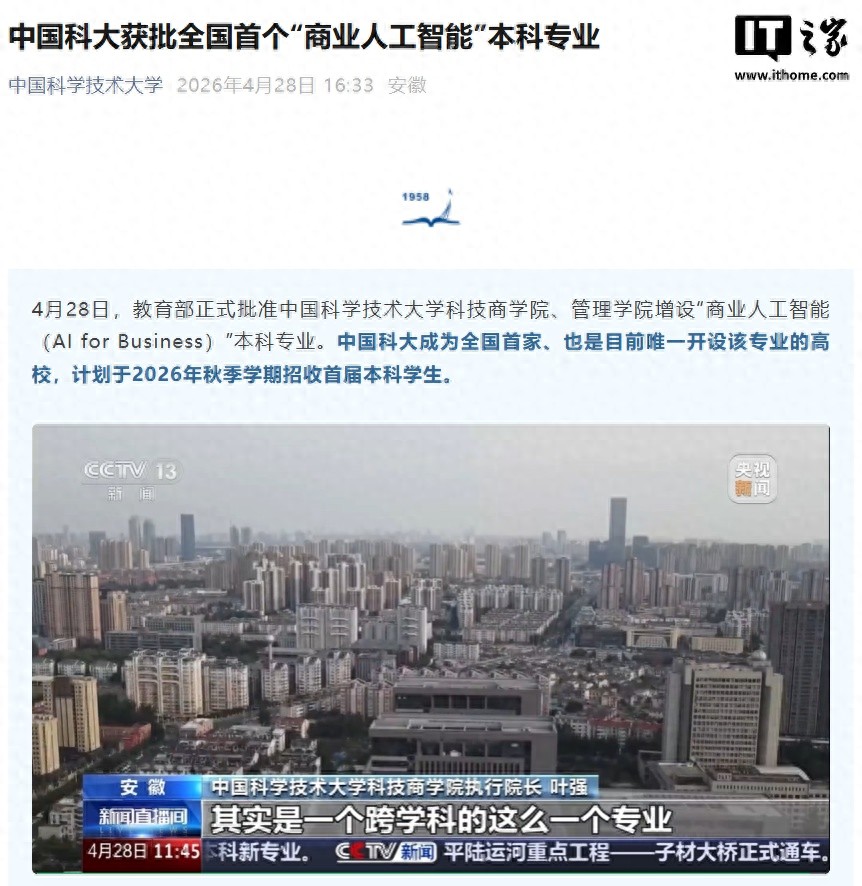
On April 28, 2026, the Ministry of Education officially approved the University of Science and Technology of China (USTC) to establish an undergraduate major in AI for Business.
USTC becomes the first and currently the only university in the country to offer this program, with plans to enroll its first undergraduate students in the Fall semester of 2026.
Program Overview
As the digital economy continues to develop, the integration of AI with business applications is becoming increasingly widespread. There is a growing demand for interdisciplinary talents who understand both technical principles and business management, which are crucial for supporting the country’s high-quality development and the intelligent upgrading of industries. In this context, USTC’s School of Science and Technology Business and School of Management spearheaded the initiative to promote the AI for Business major, which underwent nearly two years of validation before receiving approval.
The AI for Business program is positioned as non-purely technical, focusing on the integration of AI into business scenarios. The knowledge system combines foundational theories from AI and economic management, covering cutting-edge topics such as AI-driven business model innovation, AI hardware architecture and industrial ecosystem, AI principles and applications, business intelligence agents, AI-driven innovation investment, and AI governance, thereby constructing a cross-disciplinary knowledge structure that supports intelligent business decision-making.
Educational Objectives
Students will systematically master core theories in business management, artificial intelligence, mathematical optimization, and computer science. They will develop eight core competencies: integration of business AI, intelligent data analysis, human-machine collaborative decision-making, business system design, mathematical optimization and modeling, foundational business management, AI ethics and responsibility, as well as innovation practice and communication. This interdisciplinary knowledge system aims to enhance students’ core capabilities to adapt to future societal changes.
Conclusion
This initiative is part of the Ministry of Education’s ongoing efforts to optimize professional settings, guiding and supporting universities to actively establish new programs that meet national strategic needs and modern industrial development demands. The ministry has also introduced new programs in various fields, including energy science and engineering, deep earth science and engineering, and more, to drive innovation and development in emerging and future industries.
Comments
Discussion is powered by Giscus (GitHub Discussions). Add
repo,repoID,category, andcategoryIDunder[params.comments.giscus]inhugo.tomlusing the values from the Giscus setup tool.