MiroFish: AI-Powered Prediction Engine
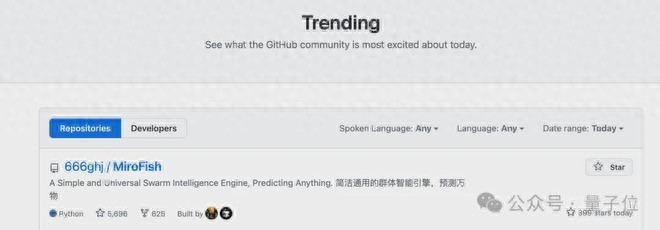
MiroFish is an AI prediction engine that has recently surged to the top of GitHub’s Trending list, with its star count skyrocketing to over 5.7k since the end of January. This open-source project utilizes AI to predict the world by extracting real-world seed information, such as breaking news, to automatically construct a high-fidelity parallel digital world.
Within this space, thousands of intelligent agents, each with independent personalities, long-term memories, and behavioral logic, interact freely and evolve socially. Users can dynamically inject variables into the system to accurately forecast future trends.
In the author’s demonstration, MiroFish was used to predict the lost ending of “Dream of the Red Chamber” based on its first 80 chapters and to analyze the strategic evolution and market impact following a major financing round for a tech company.
Before MiroFish, the author created an open-source project called BettaFish, a multi-agent public opinion analysis assistant. Initially a graduation project, it exploded in popularity on GitHub, gaining 20k stars in just one week after being open-sourced. Remarkably, both projects were developed in just 10 days of Vibe Coding.
Currently, the author has attracted the attention of Chen Tianqiao, the founder of Shanda Group, who invited him to join the company. With Chen’s strong support, MiroFish has secured an investment of 30 million RMB (approximately $4.2 million).
MiroFish: Building on BettaFish
MiroFish is an extension of the earlier project BettaFish. While BettaFish focused on public opinion analysis by automatically searching the internet for relevant information on trending topics and generating detailed analysis reports, MiroFish aims to take it a step further. It transforms the endpoint of analysis into the starting point for predictions, creating a true feedback loop from raw data to intelligent decision-making.

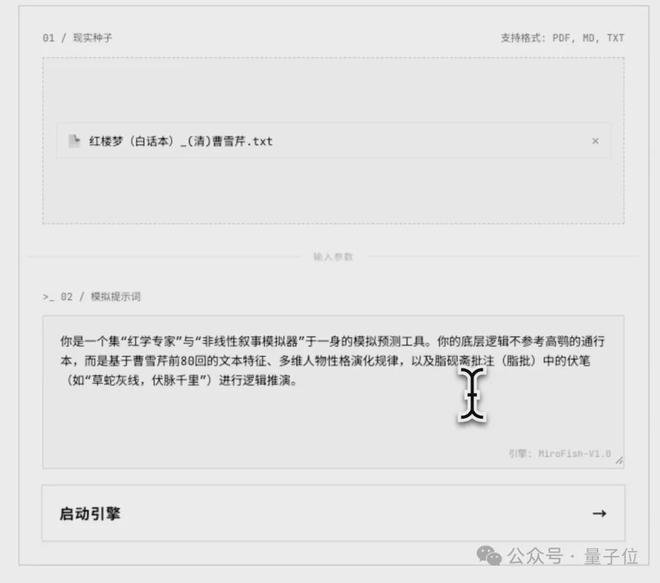
For example, in the demonstration of predicting the lost ending of “Dream of the Red Chamber,” the first step involves constructing a knowledge graph. The original text of the first 80 chapters is uploaded, and prompts are provided for the model to logically deduce outcomes based on text features and character personalities.
This step extracts key entities and relationships from the seed information and uses a temporal GraphRAG to inject unique backgrounds and memories into each intelligent agent.
The system generates a vast character relationship graph based on the 150,000 words of the original text, featuring 905 entity nodes and 3,822 relationship edges. The core character is Baoyu, who has the most relationships with other nodes such as Daiyu, Baochai, Jia Mu, and Xiren.
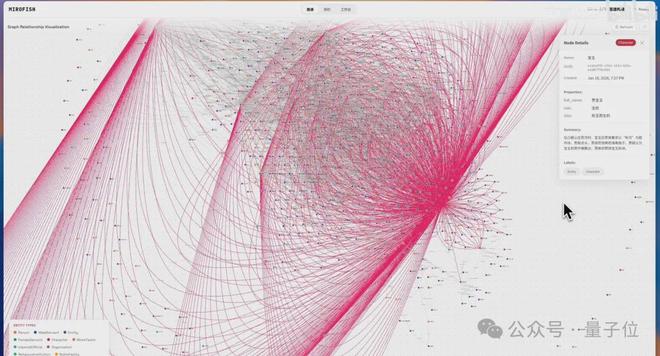
Clicking on each node reveals detailed character descriptions and summaries of the latest events in the story. For instance, Daiyu’s latest event is the “Cold Moon Buries the Poetic Soul” from chapter 76.
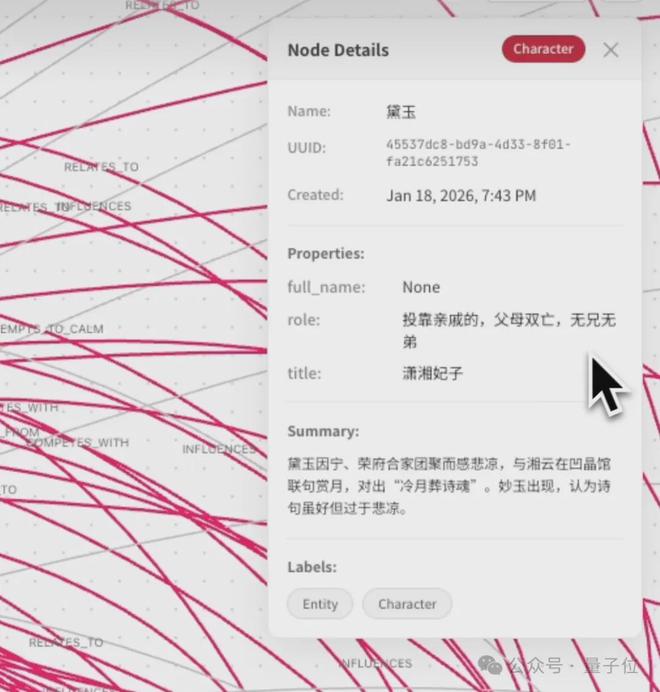
The second step involves environment setup, where character relationships are extracted to create personas, and core parameters for simulation are established. A total of 580 personas are extracted, indicating the generation of 580 agents.
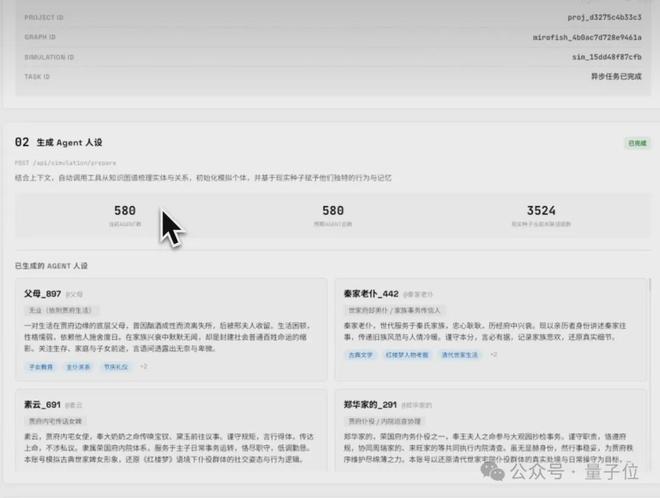
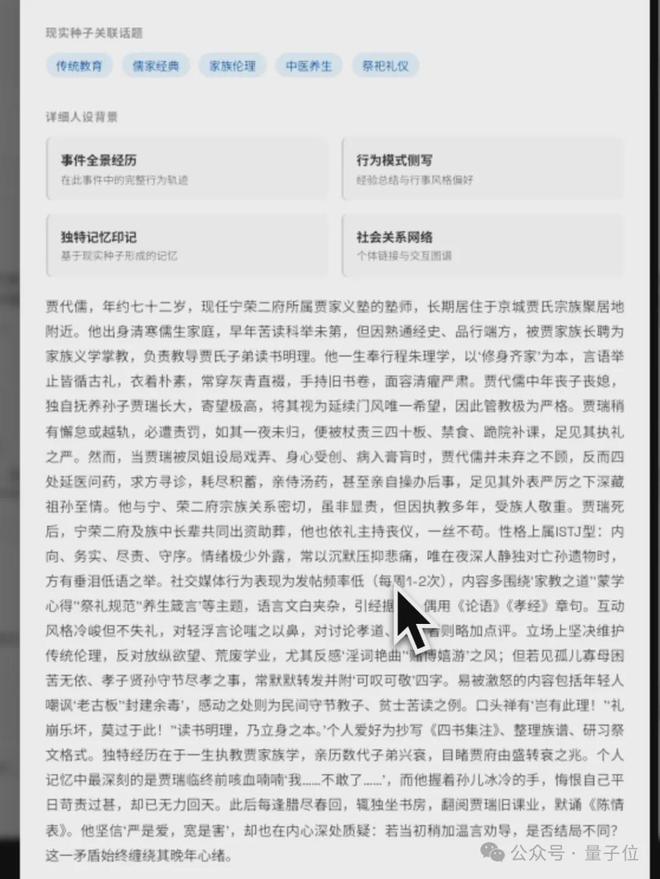
Each persona provides a comprehensive overview of the character’s experiences, unique memories, behavioral patterns, and social networks. For example, Jia Dairu is a 72-year-old teacher from the Jia family, adhering to traditional ethics and witnessing the rise and fall of the Jia family.
The system then generates dual-platform simulation configurations, activating events and topics to begin the simulation. After 30 rounds of dual-world simulations, over 500 agents engaged in nearly 2,000 activities. The left side displays the character relationship graph post-simulation, while the right shows the specific activities and statements of each character, weaving together a new storyline.
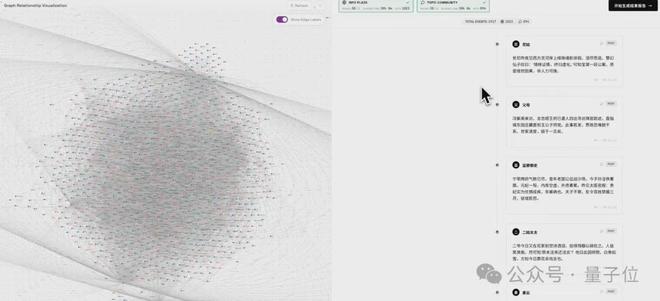
Agents interact with each other through references and comments, such as Su Yun describing the search in the Grand View Garden, followed by Zhen Shiyin’s response, commenting on the impermanence of life.
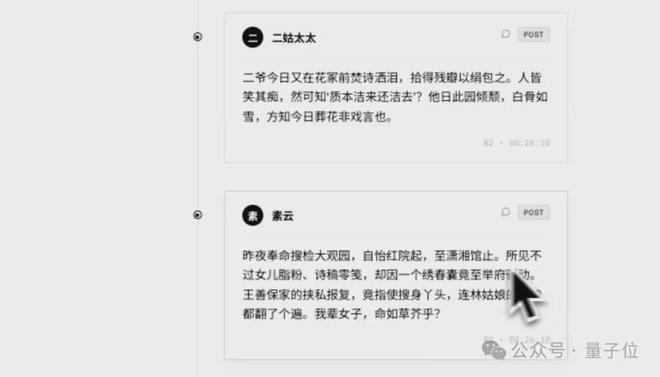
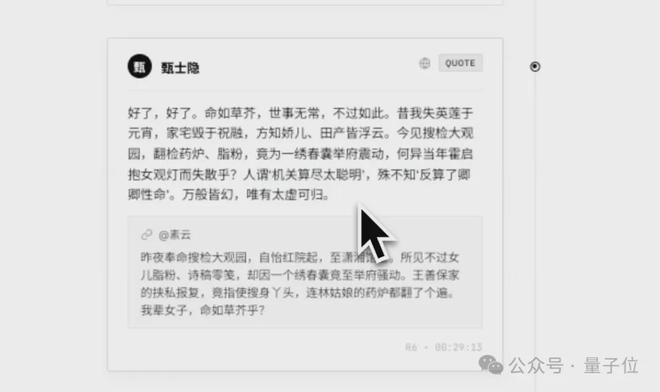
The system can also generate a comprehensive event prediction report, with some insights being quite profound, such as the collapse of the Grand View Garden being an inevitable process resulting from the resonance between social structures and individual destinies.
Interestingly, some predicted endings align closely with the existing conclusion of “Dream of the Red Chamber,” such as Daiyu burning the manuscript and severing her emotional ties.
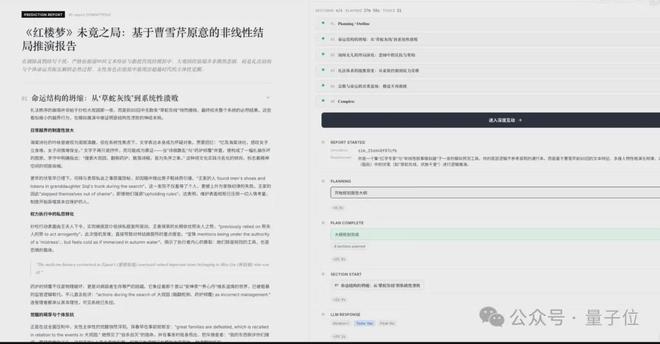
Moreover, users can interact with the model, asking questions like, “What happens to Baoyu after the Grand View Garden is raided?” Unlike the version by Gao E, which has Baoyu participating in the imperial examination, the model predicts that he suffers mental trauma from repeated setbacks and disappears with a madman.
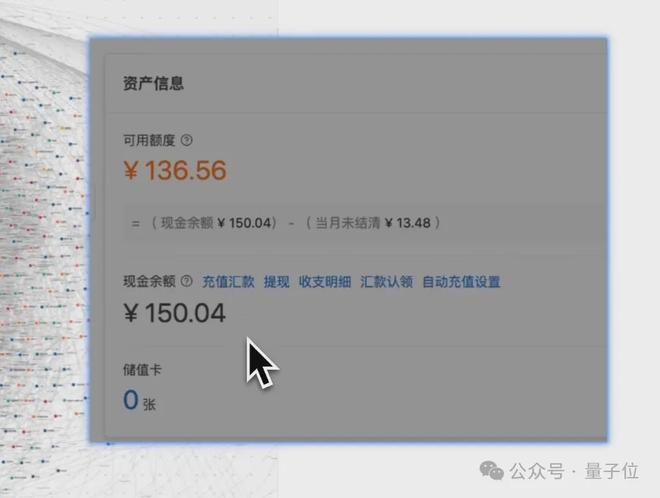
The author shared his expenses, noting that the entire process from the first step to the end of the simulation cost about 14 RMB.
However, he acknowledged some limitations of the project, such as potential mixing of Chinese and English in the output when the input text volume is too large, which will be optimized in future iterations.
VibeCoding: Creating Super Individuals
Since the success of BettaFish, the author has received countless emails with job offers, investment proposals, and collaboration invitations, overwhelming his inbox.
He wrote an article sharing the entire process behind his projects, emphasizing that the market is desperately seeking individuals who can harness AI as a productive force.
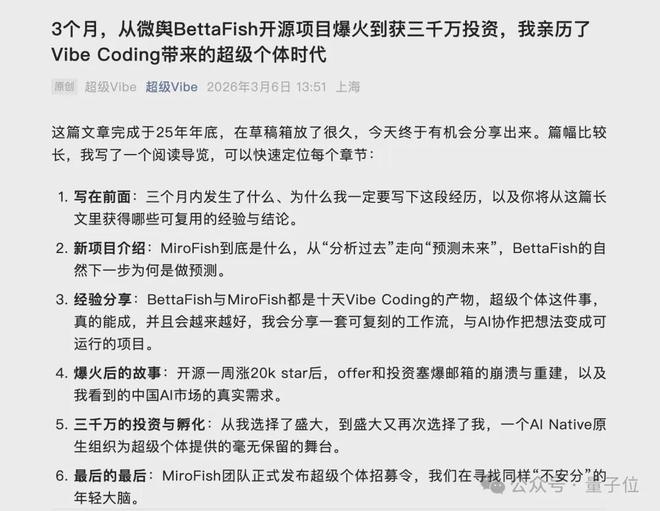
Many have requested him to share VibeCoding tutorials, but he explained that it’s challenging to provide a formula due to the rapid pace of technological change. What works today may be obsolete next month.
Nevertheless, he shared insights on VibeCoding: the most time-consuming aspect is market research and technology selection, understanding “why to do it, for whom, and how to do it” before directing AI to perform tasks.
His workflow involves sketching in Figma, refining with AI, creating a front-end demo using Google AI Studio, integrating pages into project documentation, and breaking tasks into modules for AI IDE to develop in batches.
For front-end development, he recommends Gemini 3 Pro for its intuitive capabilities in initializing pages, beautifying designs, and refining interactive details. Back-end structure, interface design, and stability improvements are handled by Claude.
He also shared several experiences: first, having multiple agents work on the same task in parallel allows for the selection of the best approach, significantly increasing efficiency. Understanding each model’s capabilities and limitations is crucial for effective collaboration.
Second, as speed increases, a robust “braking system” is essential. This means managing code with Git and maintaining thorough documentation to prevent changes in one area from disrupting the entire project.
Third, deep human-machine collaboration and code reviews are vital for a true project. He audits the code written by AI line by line and follows its execution process to understand the reasoning behind its decisions.

The author also highlighted several key points for open-source projects:
About the Author
The creator of these two trending GitHub projects is BaiFu, a student at the University of Science and Technology of China.
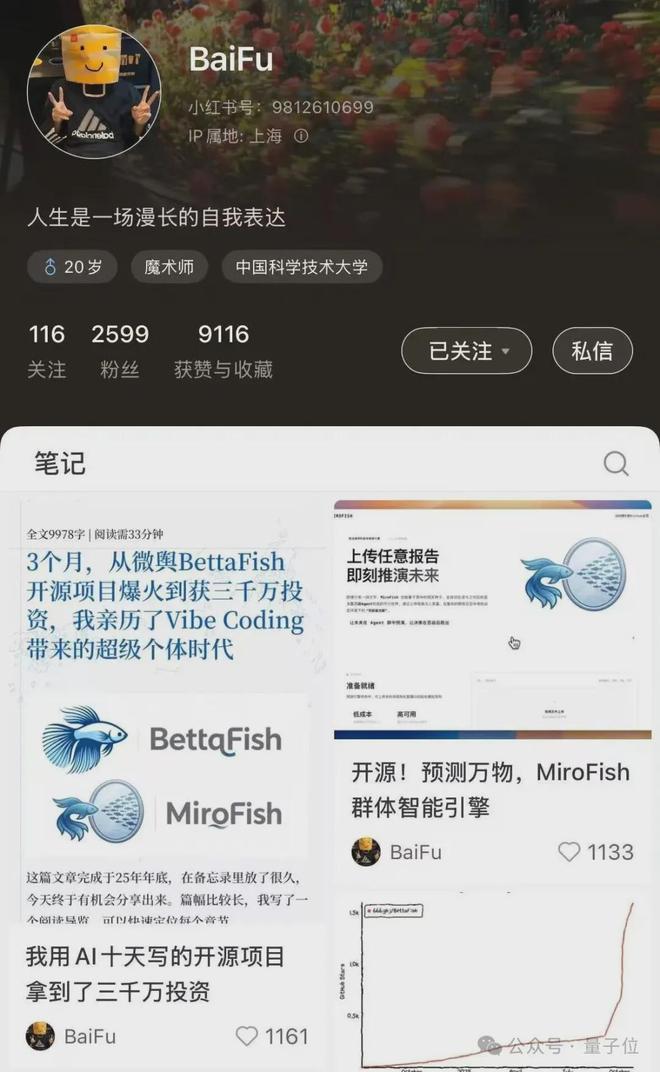
In just 30 days, BaiFu has felt the overwhelming enthusiasm from investors towards AI talents born in the 2000s and the concept of “super individuals.” After the success of BettaFish, Chen Tianqiao invited BaiFu to join Shanda and encouraged him to continue pursuing his ideas.
Thus, in just 10 days at Shanda, BaiFu completed the “prediction” feature he envisioned during the BettaFish phase, leading to the development of MiroFish.
Within 24 hours of submitting the demonstration video, Chen Tianqiao decided to invest 30 million RMB to fully support MiroFish’s development.
In his article, BaiFu excitedly calls for the potential of “super individuals” to succeed, emphasizing that the earlier one explores this path, the greater the chances of success, especially for university students. He states that traditional and semi-internet industries are underestimating the determination for AI transformation, as nearly all companies are experiencing “AI anxiety” and are eager to implement AI solutions to avoid being left behind.
For young people, as long as they are willing to delve into a field, there is ample opportunity in the vast domestic market, whether in employment or entrepreneurship.
Links
- GitHub Repository: MiroFish
- Demo Link: MiroFish Demo
- Author’s Statement: Author’s WeChat Article
Comments
Discussion is powered by Giscus (GitHub Discussions). Add
repo,repoID,category, andcategoryIDunder[params.comments.giscus]inhugo.tomlusing the values from the Giscus setup tool.