Vibe Coding: Transforming the Role of Product Managers
Vibe Coding is reshaping the way product managers work, shifting from natural language-driven development to results-oriented evaluation and iterative-driven processes. This article delves into its core concepts, technological breakthroughs, mainstream tool selection, and how to integrate AI throughout the product development process, enabling PMs to transition from information conduits to builders, driving efficient decision-making with real pages.

In 2025, a tweet sparked heated discussions in the product community; by 2026, it had become a reality in workflows. This article systematically outlines the core concepts of Vibe Coding, its underlying technological logic, mainstream tool selection, and its substantial impact on the role of product managers—helping you understand the buzzwords and use the tools effectively.
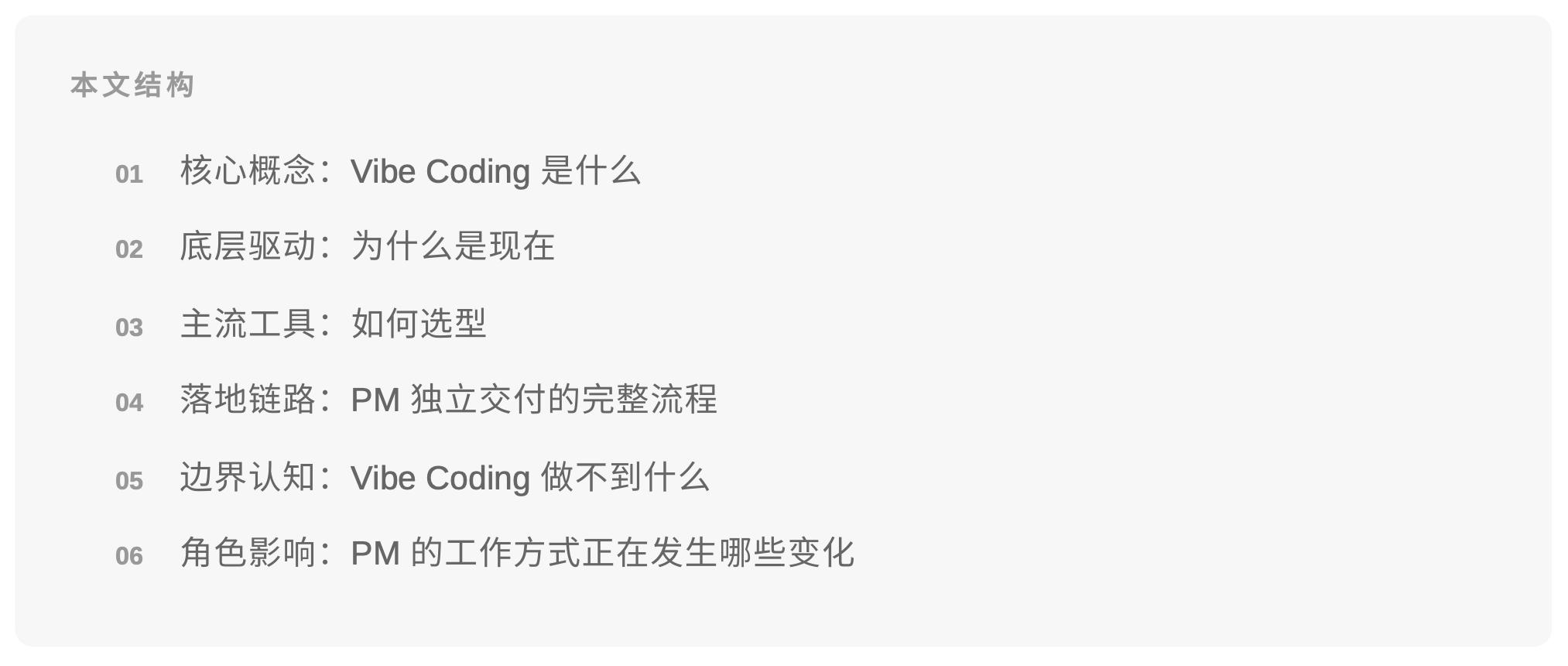
01 Core Concept: Clarifying the Terms
In the past year, “Vibe Coding” has frequently appeared in discussions among product managers, but many remain unclear about what it is and what it can do. This is the starting point for understanding everything.

This definition has three key terms worth unpacking:
- Natural Language Driven — No need to master any programming syntax; describe the desired functionality and effects in everyday language, and AI translates intentions into code.
- Results-Oriented Evaluation — The role of humans shifts from “writing code” to “evaluating results.” You do not need to understand the code generated by AI; you only need to assess whether the output is correct and satisfactory.
- Iterative-Driven Convergence — It is not about generating a complete product in one go, but rather continuously iterating through multiple rounds of natural language feedback to gradually approach the goal.

02 Underlying Drivers: Why 2025–2026?
The idea behind Vibe Coding is not new; it has been in its infancy since the era of GitHub Copilot. However, it truly became a productivity tool because three conditions matured simultaneously in 2025–2026.
Condition 1: Leap in Model Coding Capabilities
The authoritative benchmark for measuring AI programming capabilities is SWE-bench Verified—testing the model’s ability to solve real GitHub issues, which is much harder than simply writing runnable code. The latest data shows:

This means that models can now handle coding tasks in real complex projects, rather than just generating isolated code snippets. This is the prerequisite for Vibe Coding to be truly practical.
Condition 2: Toolchain Completes the “Last Mile” Packaging
AI being able to write code is one thing; enabling non-technical personnel to access a runnable product is another. The missing element was not the model’s capability, but the environment configuration, debugging, and deployment barriers—which kept 99% of PMs out. The new generation of tools emerging since 2025 has completely encapsulated these barriers, allowing PMs to obtain runnable pages without needing to understand any engineering infrastructure.
Condition 3: Non-Developers Become the Main User Group
Data from 2026 shows that 63% of active users of Vibe Coding tools are non-developers. Product managers, designers, and entrepreneurs have become the primary users of these tools—indicating that the ease of use has crossed the threshold of “only technical people can use it.”
03 Mainstream Tools: How to Choose and What Are the Differences
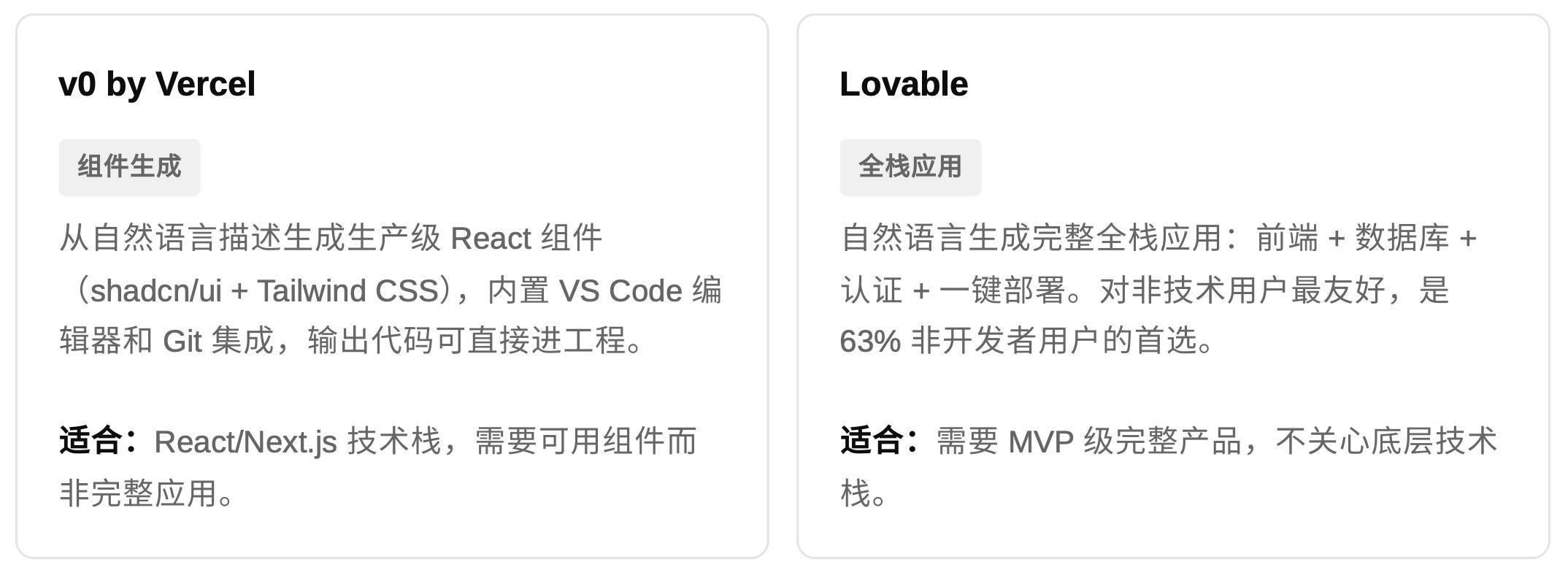
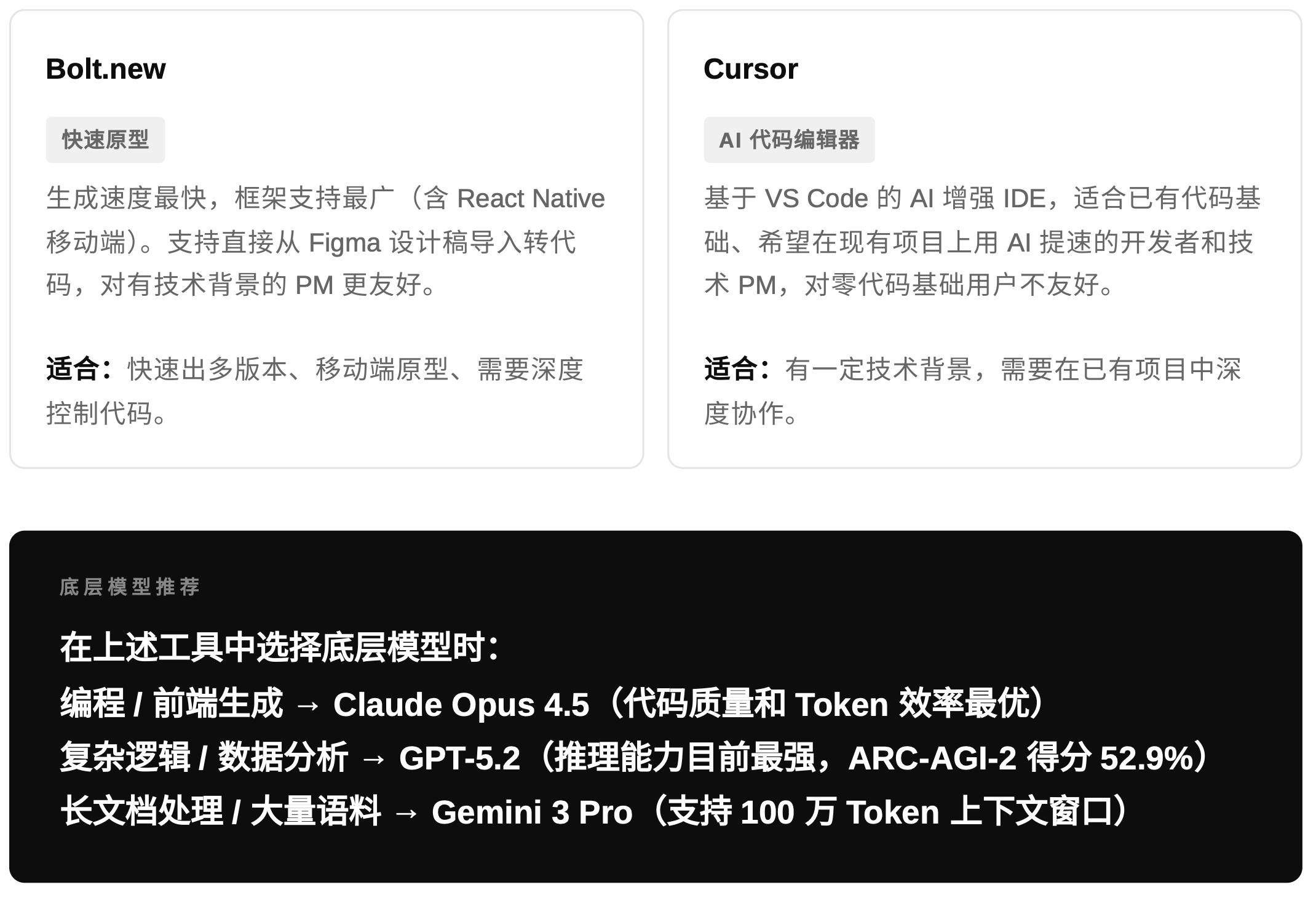
Current Vibe Coding tools on the market are clearly stratified; there is no “best one,” only the “most suitable for the current task.” Here are the core differences among mainstream tools:
04 Implementation Path: How PMs Can Integrate It into Real Workflows
Here is a workflow that has been successfully implemented in actual projects—from a requirements discussion meeting to initiating reviews with a clickable page, AI assists throughout the process, allowing one person to complete it within a week.
The essence is embedding AI into the entire delivery chain, rather than just using it to generate a screenshot:
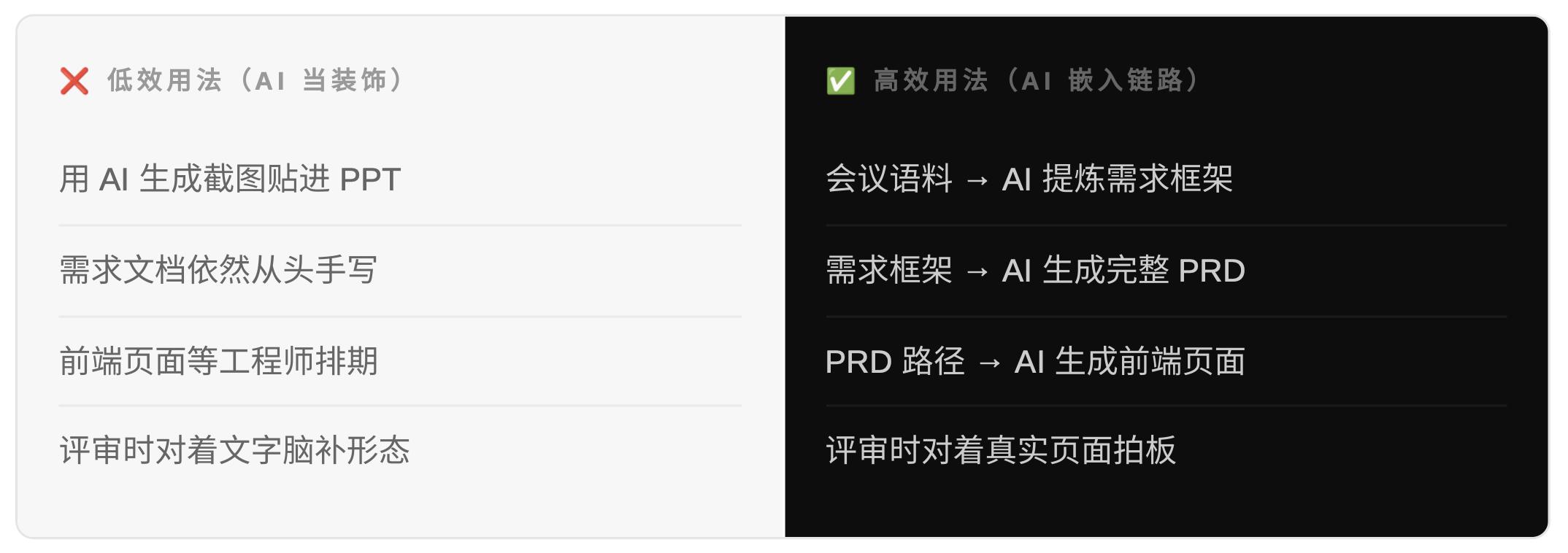
1. Corpus Organization: Let AI Filter Meeting Noise
Directly feed the verbatim transcript or recording of the meeting to a large model, asking it to extract three categories of information: “real needs / pseudo-needs / items to confirm.” Clearly restrict AI from adding any content not mentioned in the meeting.
→ Key Point: This step is filtering, not generating. The value of AI lies in helping you extract effective signals from a large amount of colloquial information.
2. Requirement Structuring: Generate a PRD Framework in Four Parts
Use a fixed framework prompt to guide AI in outputting a four-part structure: requirement statement → solution alignment → feasibility discussion → priority sorting. After obtaining the framework, manually review and cross-check with the original corpus.
→ Key Point: AI excels at filling structures but struggles with assessing importance. Priority sorting must be decided by humans and cannot be entrusted to the model.
3. Function Breakdown: Generate a Development-Ready PRD
Feed the framework back to AI, adding user stories, acceptance criteria, and data field descriptions to produce a detailed PRD that engineers can start working on without further questions.
→ Key Point: The granularity standard is “no ambiguity on the development side,” not pursuing document length.
4. Vibe Coding: Turn Requirements into Clickable Real Pages
Combine the core path descriptions of the PRD into prompts and input them into Vibe Coding tools, iterating 2–3 rounds to generate a browser-runnable demo version. Tool selection: for complete full-stack options, choose Lovable (one-click deployment); for rapid multi-version output, choose Bolt (fastest, supports direct code conversion from Figma); for underlying models, recommend Claude Opus 4.5.
→ Key Point: The goal is to “enable the business side to make decisions based on tangible items,” not to deliver production code.
5. Business Review: Drive Decisions with Real Pages
Initiate reviews with the clickable page. Discussions no longer revolve around “what does this sentence mean,” but rather “is this button placed correctly”—enhancing both decision-making efficiency and quality.
→ Key Point: The value of the review lies not in “passing,” but in exposing all disagreements in front of the page, eliminating later rework.
05 Boundary Awareness: What Vibe Coding Cannot Do
Accurately understanding a technology requires knowing not only what it can do but also where its boundaries lie. Having excessive expectations or completely rejecting Vibe Coding are both cognitive biases.

06 Role Impact: How PM Work Styles Are Changing
Two sets of data illustrate the issue:

Change 1: The Role of PMs is Shifting from “Connectors” to “Builders”
In the past, the core value of PMs was alignment and coordination: translating business needs to designers and translating designs to engineers, acting as information conduits. Now, when PMs can independently run demo versions, they are no longer just “storytellers” in reviews but “people who come to the conversation with works.” Their authority and pace of advancement will undergo a qualitative change.
Change 2: The Quality Threshold for Requirement Reviews is Elevated
When the PM across the table comes to the review with a real clickable page, PMs who only bring written PRDs will clearly be at a disadvantage—the business side is increasingly accustomed to making decisions based on tangible items rather than relying on imagination to understand requirements. This change has become very evident in 2026.
Change 3: The Boundaries Between PMs and Engineers are Redefined
This is not about “PMs taking engineers’ jobs” but rather about redefining the work interface: PMs are responsible for the transition from ideas to demo-level products, while engineers handle the transition from demo-level to production-level. This enhances efficiency for both parties, rather than being a zero-sum game.
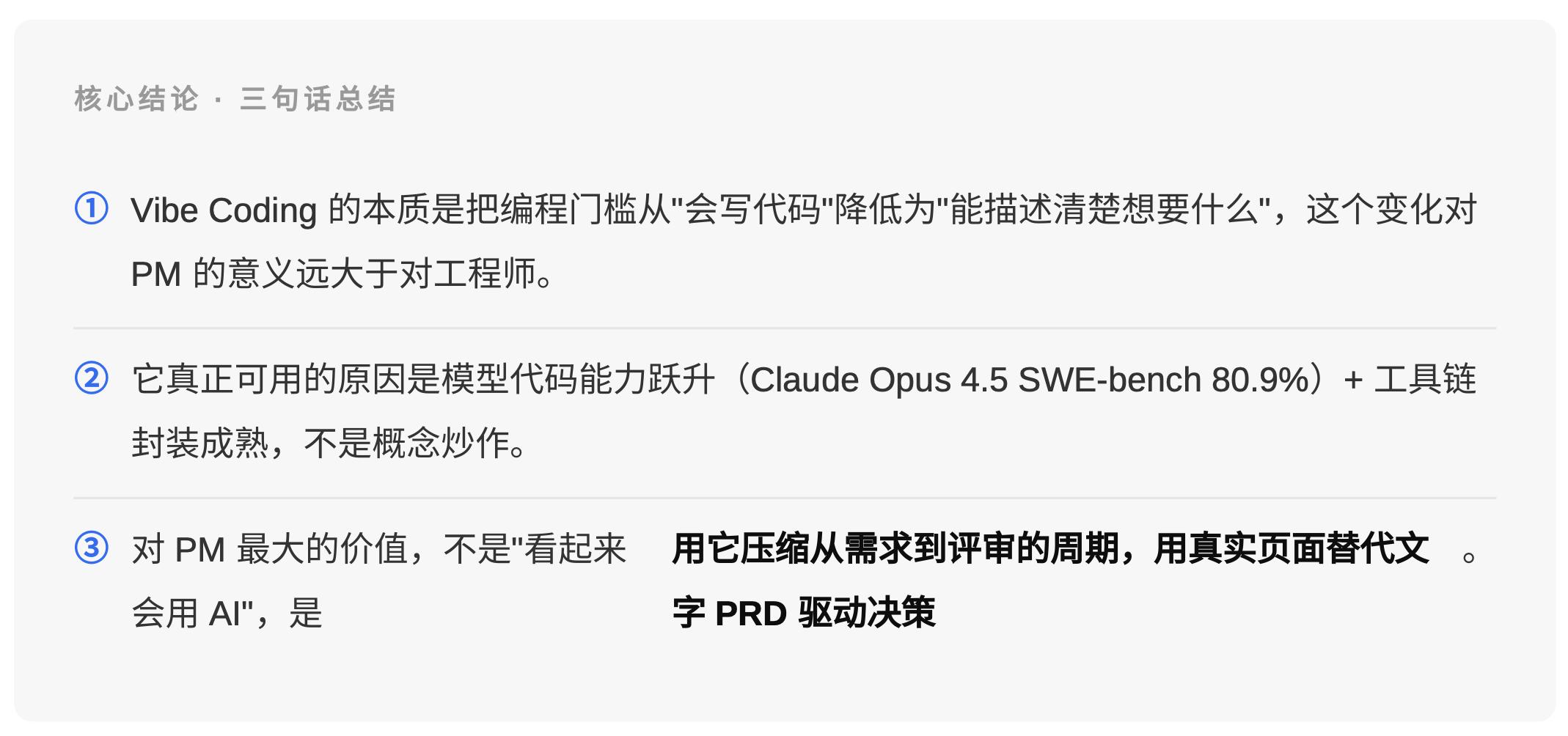
If you haven’t tried this process yet, it’s recommended to start with the smallest scenario: in the next iteration, for a new page, try running a version using Vibe Coding yourself and take it to the review. Observe the changes in decision-making efficiency.
You will find that many issues that were unclear in requirement meetings will clarify themselves in front of a real page.
Comments
Discussion is powered by Giscus (GitHub Discussions). Add
repo,repoID,category, andcategoryIDunder[params.comments.giscus]inhugo.tomlusing the values from the Giscus setup tool.